Online Casino Licenses in 2026 – Compare Regulators & Verify Any License
Online casino licenses are your safety net. They set the rules, audit the games, and keep your money separate from a casino’s cash. Before an operator can legally accept players, it has to prove it can meet strict regulatory standards, from protecting customer funds to offering independently tested games and responsible gambling tools. I treat licenses as the first filter. If a site can’t show one, I’m out. When we review online casinos, we look beyond the badge in the footer. The strongest online casino licenses require segregated player funds, independently tested games, and a genuine complaints process if something goes wrong. At the same time, regulators don’t all work to the same standard. Some respond faster than others, and a license is never a guarantee of a great casino. It provides a legal baseline, not a promise of a perfect experience.
How to Check a Casino’s License in Under a Minute
A casino can claim to be licensed, but that doesn’t mean the license is genuine or still active. Fortunately, verifying one only takes a minute once you know where to look. Whenever we test a new casino, these are the same checks we make before we even register an account.
1. Scroll to the Footer
Start at the bottom of the homepage. A legitimate casino will normally display the regulator’s name, license number, company name, and registered business address together in the footer. For example, a Malta Gaming Authority license might appear as MGA/B2C/123/2023, alongside the legal company operating the casino. If you only see a logo without a license number, or there’s no company information anywhere on the site, it’s worth taking a closer look before signing up.
2. Click the License Seal
Many casino regulators provide operators with an official license seal or logo that links directly to the regulator’s public certificate. Clicking it should take you away from the casino’s website and onto the regulator’s official domain. If the badge doesn’t do anything, links back to another page on the casino itself, or is simply a static image, don’t assume it’s genuine. Fake casino license claims often rely on copied logos that look convincing until you try to verify them.
3. Check the Regulator’s Official Register
The safest way to verify a casino license is through the regulator’s own register. Most casino licensing authorities maintain searchable databases where you can enter the license number, company name, or casino brand to confirm the details. Whether you’re checking an MGA license, UKGC license, Curaçao license, AGCO license, or another major regulator, always use the official register rather than relying solely on what appears on the casino’s website. We’ll also link to each regulator’s official register throughout this guide to make the process easier.
4. Confirm the License Status
Finding the license isn’t the final step. Make sure it’s still listed as Active or Valid. If the register shows Suspended, Expired, Revoked, or another inactive status, take extra care before depositing. An inactive license doesn’t automatically mean a casino is unsafe, but it does remove one of the strongest protections available to players. In those cases, it’s worth spending a few extra minutes researching the operator before deciding whether you feel comfortable playing there.
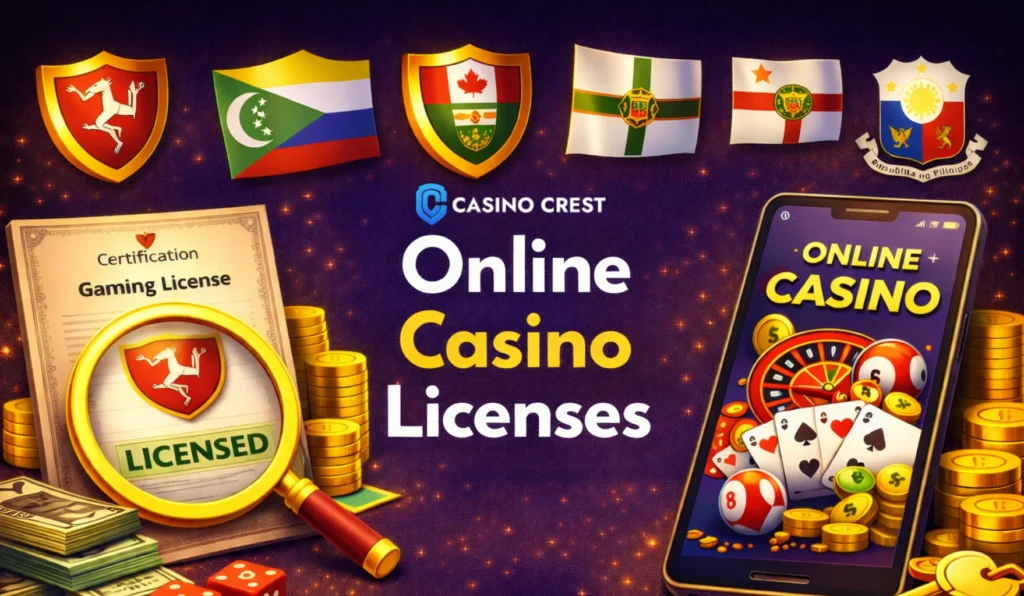
What a Casino License Is and What It Guarantees
An online casino license is an approval issued by a gambling regulator that allows an operator to offer casino games legally in specific markets. Before granting that license, regulators expect operators to prove three things: that the business is financially stable, that its games use independently tested Random Number Generators (RNGs), and that it can protect players through secure systems, responsible gambling tools, and proper handling of customer funds.
Those requirements are why casino licenses matter. They create standards every licensed operator has to meet before accepting real-money players.
Segregated Player Funds
One of the biggest advantages of licensed casinos is that player balances are kept separate from the operator’s day-to-day business money. If a casino runs into financial trouble, those funds are less likely to be treated as company assets. Some of the strongest regulators, including the Isle of Man GSC, go even further by requiring trust accounts or bank guarantees that provide additional protection.
Independently Tested Games
Licensed operators can’t simply publish games and claim they’re fair. Independent testing laboratories such as eCOGRA, GLI, and iTech Labs verify the Random Number Generator (RNG) and confirm that published RTP figures accurately reflect long-term game performance. These aren’t one-time approvals either. Regulators require ongoing testing to make sure games continue to meet the expected standards.
A Real Complaints Process
Even well-run casinos occasionally have disputes. A license gives players somewhere to turn if an issue can’t be resolved directly with the operator. Depending on the jurisdiction, approved dispute resolution services such as IBAS or eCOGRA may review complaints, while regulators can investigate operators and, where necessary, issue fines or suspend licenses.
Verified Ownership
Licensed casinos don’t operate anonymously. Regulators require operators to disclose the company behind the casino, its registered address, ownership structure, and licensing details. Before approval, directors and key individuals are usually vetted to make sure they meet the regulator’s suitability requirements. Those details should also be easy to find on the casino’s website.
Fair Bonus Terms
Most established casino regulators expect promotions to be presented clearly and fairly. They review bonus terms for misleading wording or unfair conditions, helping prevent practices such as hidden wagering requirements or confusing withdrawal restrictions. While every bonus still has terms attached, licensed operators are expected to make those conditions transparent.
Responsible Gambling Tools
Player protection goes beyond game fairness. Licensed casinos are expected to provide responsible gambling tools, including deposit limits, loss limits, reality checks, session reminders, cooling-off periods, and self-exclusion options. These features help players stay in control and are a core requirement under most major regulatory frameworks. You can learn more in our Responsible Gambling guide.
B2C vs B2B Licenses
You’ll often see both B2C and B2B licenses mentioned. A B2C license covers the casino operator that accepts your bets, while a B2B license applies to the companies supplying the games and technology behind the platform. Together with our Software Providers Hub, they help explain why both the casino and its game suppliers are subject to regulatory oversight.
Licensed vs Unlicensed Casinos
Not all online casinos offer the same level of protection. A licensed casino has to meet certain standards before it can accept players, while an unlicensed operator answers only to itself. That doesn’t mean every unlicensed casino is dishonest, but it does mean you’ll have fewer protections if something goes wrong.
When we review casinos, licensing is always one of the first things we check. A recognized license doesn’t guarantee a perfect experience, but it does provide independent oversight, accountability, and clear rules that operators must follow.
| Licensed Casino | Unlicensed Casino |
|---|---|
| Operates under a recognized gambling regulator | No independent regulatory oversight |
| Player funds must meet regulatory protection requirements | No guaranteed protection for customer balances |
| Games use independently tested RNGs | Game fairness may not be independently verified |
| Players can escalate complaints through recognized channels | Disputes are handled solely by the casino |
| Company ownership and license details are publicly disclosed | Ownership and company information may be limited or unavailable |
| Responsible gambling tools are normally required | Responsible gambling features may be limited or absent |
| Subject to audits, compliance reviews, and possible enforcement | No regulator is monitoring ongoing compliance |
Casino Licenses Compared
Not all online casino licenses offer the same level of protection, but that doesn’t mean they’re either “good” or “bad.” Every regulator below oversees legitimate operators. The differences come from how they protect player funds, how disputes are handled, how quickly regulators enforce their rules, and the markets they supervise.
As a general rule, we consider UKGC, MGA, and the Isle of Man GSC the safest default for most players because they combine strong financial safeguards with active regulatory oversight.
Regulators such as AGCO and Alderney AGCC also maintain high standards within their markets, while Curaçao and Anjouan have introduced important reforms in recent years that have significantly strengthened their licensing frameworks. A lower-tier license isn’t automatically a red flag, but it’s worth understanding what protections it offers before you sign up.
| Regulator | Market | Player Fund Protection | Crypto-Friendly | Protection Tier |
|---|---|---|---|---|
| UK Gambling Commission (UKGC) | United Kingdom | Segregated player funds required | No | Tier 1 – Strictest |
| Malta Gaming Authority (MGA) | Europe/ International | Segregated player funds required | Limited | Tier 1 – Strictest |
| Isle of Man GSC | International | Trust accounts or bank guarantees | Yes | Tier 1 – Strictest |
| Alderney AGCC | International | Strong financial controls | Limited | Tier 2 – Strong |
| AGCO (Ontario) | Ontario, Canada | Strict player protection rules | No | Tier 2 – Strong |
| Kahnawake Gaming Commission | Canada/ International | Operator fund requirements | Yes | Tier 2 – Strong |
| PAGCOR | Philippines/ Asia | Licensed operator oversight | Limited | Tier 2 – Strong |
| Curaçao Gaming Authority | Global/ Offshore | New player protection requirements under LOK | Yes | Tier 3 – Developing |
| Anjouan Gaming Authority | Global/ Offshore | Modern compliance framework | Yes | Tier 3 – Developing |
Why We Rank Them This Way
Each regulator below offers genuine legal oversight, but they don’t all take the same approach. Some prioritize player fund protection, others focus on enforcement, while newer jurisdictions continue strengthening their regulatory frameworks to meet international expectations. Rather than asking which license is simply “best,” we think it’s more useful to understand what each one does well and where its limitations lie. That’s ultimately what helps you choose a casino with confidence.
The Main Casino Licensing Authorities
Each regulator below offers genuine legal oversight, but they don’t all take the same approach. Some prioritize player fund protection, others focus on enforcement, while newer jurisdictions continue strengthening their regulatory frameworks to meet international expectations. Rather than asking which license is simply “best,” we think it’s more useful to understand what each one does well and where its limitations lie. That’s ultimately what helps you choose a casino with confidence.
Malta Gaming Authority (MGA)
The Malta Gaming Authority (MGA) is probably the license we come across most often when reviewing international casinos. It regulates many of the industry’s biggest brands and strikes a balance between strong player protections and a licensing framework that works across multiple markets. Operators licensed by the MGA must separate player balances from company funds, meet AML and KYC obligations, use independently certified gaming software, and pass regular compliance reviews.
Another reason the MGA has such a strong reputation is its dispute process. Players have a clear route for escalating complaints if they can’t resolve an issue directly with the casino. Investigations aren’t always as quick as players would like, but the MGA remains one of the most respected regulators in online gambling.



 Number of games
  Providers
  Minimum Deposit
  Maximum Withdrawl
  Payout time
  Wagering Requirement
  Loyalty Program
  Jackpot Games
  Welcome Bonus
  Other Bonuses
  100% up to $100 + 50 FS on Thor: The Trials of Asgard


 Number of games
Providers
Minimum Deposit
Maximum Withdrawl
Payout time
Wagering Requirement
Loyalty Program
Jackpot Games
Welcome Bonus
Other Bonuses
Number of games
Providers
Minimum Deposit
Maximum Withdrawl
Payout time
Wagering Requirement
Loyalty Program
Jackpot Games
Welcome Bonus
Other Bonuses  125 Free Spins on Rich Wilde and the Book of Dead


 Number of games
Providers
Minimum Deposit
Maximum Withdrawl
Payout time
Wagering Requirement
Loyalty Program
Jackpot Games
Welcome Bonus
Other Bonuses
Number of games
Providers
Minimum Deposit
Maximum Withdrawl
Payout time
Wagering Requirement
Loyalty Program
Jackpot Games
Welcome Bonus
Other Bonuses Curaçao Gaming Authority
The Curaçao Gaming Authority remains one of the most recognized offshore regulators, particularly among crypto casinos and international operators. While it was once criticized for lighter oversight, the regulatory framework has changed considerably. Under the LOK (National Ordinance for Games of Chance) reforms introduced in 2024, operators must meet stronger licensing, compliance, AML, governance, and player protection requirements than under the previous master license system.
The biggest improvement is greater regulatory oversight. The new framework introduces clearer supervision, higher compliance expectations, and stronger accountability for licensees while improving player protections. Although the reforms represent a major step forward, the new system is still developing. As the updated framework matures, enforcement practices will continue to evolve.
 $10,000 + 180 Free Spins


 Number of games
Providers
Minimum Deposit
Maximum Withdrawl
Payout time
Wagering Requirement
Loyalty Program
Jackpot Games
Welcome Bonus
Other Bonuses
Number of games
Providers
Minimum Deposit
Maximum Withdrawl
Payout time
Wagering Requirement
Loyalty Program
Jackpot Games
Welcome Bonus
Other Bonuses  400% up to €2,000 + 100 Free Spins


Code copied!
Number of games
Providers
Minimum Deposit
Maximum Withdrawl
Payout time
Wagering Requirement
Loyalty Program
Jackpot Games
Welcome Bonus
Other Bonuses Anjouan Gaming Board
The Anjouan Gaming Authority has become an increasingly popular licensing jurisdiction for international online casinos. This applies especially among crypto operators and software suppliers. Operators must complete licensing checks covering company ownership, AML compliance, technical audits, and ongoing operational standards. The regulator has also expanded its B2B licensing framework, allowing software providers and gaming platforms to obtain regulatory approval alongside casino operators.
Its greatest strength is its modern approach to international online gambling, combining relatively efficient licensing with increasingly robust compliance expectations. While standards have improved considerably, Anjouan remains a developing jurisdiction and does not yet have the same long-established enforcement record as regulators such as the UKGC or MGA.
 $1,000 + 350 Free Spins
  Number of games
Providers
Minimum Deposit
Maximum Withdrawl
Payout time
Wagering Requirement
Loyalty Program
Jackpot Games
Welcome Bonus
Other Bonuses
Number of games
Providers
Minimum Deposit
Maximum Withdrawl
Payout time
Wagering Requirement
Loyalty Program
Jackpot Games
Welcome Bonus
Other Bonuses  100% up to $750 + 50 chances to win $1m
  Number of games
Providers
Minimum Deposit
Maximum Withdrawl
Payout time
Wagering Requirement
Loyalty Program
Jackpot Games
Welcome Bonus
Other Bonuses
Number of games
Providers
Minimum Deposit
Maximum Withdrawl
Payout time
Wagering Requirement
Loyalty Program
Jackpot Games
Welcome Bonus
Other Bonuses Kahnawake Gaming Commission
The Kahnawake Gaming Commission has regulated online gambling since the late 1990s and remains an established licensing authority for international operators, particularly those serving North American markets. Licensees must satisfy licensing requirements covering security, game fairness, AML compliance, and operational integrity. Operators are also required to host their infrastructure within Mohawk Internet Technologies (MIT), giving the Commission greater oversight of licensed platforms.
Its standout strength is that close technical supervision through the MIT hosting requirement, which creates an additional level of operational accountability beyond licensing alone. Complaint handling can sometimes take longer than under larger European regulators, so dispute resolution may not always move as quickly as players expect.
 $3,500 + 350 Free Spins
 Number of games
Providers
Minimum Deposit
Maximum Withdrawl
Payout time
Wagering Requirement
Loyalty Program
Jackpot Games
Welcome Bonus
Other Bonuses
Number of games
Providers
Minimum Deposit
Maximum Withdrawl
Payout time
Wagering Requirement
Loyalty Program
Jackpot Games
Welcome Bonus
Other Bonuses United Kingdom Gambling Commission (UKGC)
If we see a UK Gambling Commission (UKGC) license, it’s usually a positive sign. The regulator has earned its reputation by holding operators to some of the toughest standards in online gambling, covering everything from financial stability and anti-money laundering to player protection and responsible gambling. That oversight doesn’t stop once a casino receives its license. Operators must verify customers, protect player funds, use independently tested games, and continue meeting compliance requirements throughout the life of the license.
Where the UKGC stands out is in enforcement. It doesn’t hesitate to investigate operators, issue substantial fines, or suspend licenses when standards aren’t met. That’s a major reason we place it among the strongest regulators in the industry. The trade-off is that UKGC casinos tend to be less crypto-friendly, and their licenses are aimed specifically at the British market rather than international players.
Isle of Man Gambling Supervision Commission (GSC)
The Isle of Man Gambling Supervision Commission (GSC) doesn’t license nearly as many casinos as the UKGC or MGA, but the operators it does approve generally have an excellent reputation. Before granting a license, the Commission carries out detailed financial checks, requires independently tested games, and expects operators to meet strict AML and compliance standards.
One feature that really sets the Isle of Man apart is its approach to player funds. Many licensees must hold customer balances in trust accounts or provide equivalent financial guarantees, giving players an additional layer of protection. Its biggest limitation is simply scale. Compared with other leading regulators, relatively few casinos operate under an Isle of Man license.
Alderney Gambling Control Commission (AGCC)
The Alderney Gambling Control Commission (AGCC) regulates operators serving international markets and has built a strong reputation for technical compliance and operational oversight. Licensees must meet rigorous standards covering financial reporting, software testing, internal controls, cybersecurity, AML procedures, and ongoing regulatory audits before and after approval.
One of Alderney’s greatest strengths is the depth of its technical regulation. The Commission places considerable emphasis on operational integrity, making it a respected license among established online gambling businesses. The regulator has a smaller market presence than the MGA or UKGC, so players will encounter fewer casinos operating exclusively under an Alderney license.
Alcohol and Gaming Commission of Ontario (AGCO)
The Alcohol and Gaming Commission of Ontario (AGCO) oversees Ontario’s regulated online gambling market. Rather than serving global operators, its primary focus is protecting players within Canada’s largest regulated province. Operators must comply with comprehensive rules covering responsible gambling, advertising standards, identity verification, AML procedures, cybersecurity, and independent game testing before offering services to Ontario residents.
AGCO’s greatest strength is consumer protection. The regulator places significant emphasis on transparency, responsible gambling, and operator accountability while maintaining active supervision of licensed casinos. The main limitation is geographical scope. An AGCO license only permits operators to serve Ontario, so it isn’t intended for broader international markets.
Philippine Amusement and Gaming Corporation (PAGCOR)
The Philippine Amusement and Gaming Corporation (PAGCOR) regulates gambling activities within the Philippines and remains an important licensing authority across Asia despite recent changes to its offshore gambling framework. Operators must comply with licensing requirements covering financial reporting, responsible gambling, AML controls, technical standards, and regular regulatory oversight throughout the license period.
PAGCOR’s greatest strength is its long experience regulating Asian gambling markets and maintaining structured oversight of licensed domestic operators. Following the wind-down of the POGO offshore licensing program, its international role has become more limited than in previous years, making the regulator more regionally focused than many global licensing authorities.


Although my interest in the tech world led to the beginning of my writing career, it was the world of online casinos that turned it into a passion. The dynamic nature of online casinos continues to capture my attention. …
 Written by: Hristijan LoleskiEdited by: Kosta Kostadinov
 Last updated on: July 27, 2026
Frequently Asked Questions
The UK Gambling Commission (UKGC), Malta Gaming Authority (MGA), and Isle of Man GSC are generally regarded as the strongest casino regulators. They require high standards for player fund protection, independently tested games, and clear procedures for handling complaints.
Yes, but only in legitimate situations. For example, a casino may withhold winnings if it finds evidence of fraud, bonus abuse, or breaches of its terms and conditions. If you believe a licensed casino has withheld your winnings unfairly, you can usually escalate the dispute through the regulator or an approved dispute resolution service.
Yes, many are. Regulators such as Curaçao and Anjouan now license operators that accept cryptocurrencies, provided they meet licensing, AML, and compliance requirements. If you play with digital assets, it’s worth checking that cryptocurrency payments are covered by the casino’s license rather than assuming they’re automatically permitted.
Many online casinos serve players in several countries, each with its own regulatory requirements. A casino might hold an MGA license for much of Europe, an AGCO license for Ontario, and another license for additional international markets. Holding multiple licenses doesn’t automatically make a casino better, but it usually shows that the operator is committed to complying with the rules in different jurisdictions.
Start by checking the casino’s footer for the regulator’s name, license number, and legal company details. Then visit the regulator’s official website and search for the license number or company name in its public register. A genuine license should appear as Active or Valid. If a casino only displays a logo without verifiable details, take extra care before registering.
Yes, provided it’s issued under Curaçao’s current licensing framework. The jurisdiction has strengthened its regulations through the LOK (National Ordinance for Games of Chance) reforms, replacing the old master license system with greater oversight and stricter compliance requirements. While many players still prefer regulators such as the UKGC or MGA, a modern Curaçao license now offers stronger protection than its previous reputation suggests.
If a casino’s license is suspended, revoked, or expires, it may no longer be authorized to accept players in that jurisdiction. You should then stop making new deposits and check the regulator’s announcements for guidance on withdrawals or unresolved complaints. Losing a license doesn’t automatically mean player funds disappear, but it does remove an important layer of regulatory protection.
There isn’t a single “best” license for every crypto casino, but Curaçao, Anjouan, and the Isle of Man GSC are among the jurisdictions most commonly associated with crypto-friendly operators. The right choice depends on what matters most to you. If you prioritize cryptocurrency support, those regulators are often more flexible.
